
The continued growth of AI is binding the worlds of computer science and health care ever more closely – opening new avenues of collaboration, design and education.
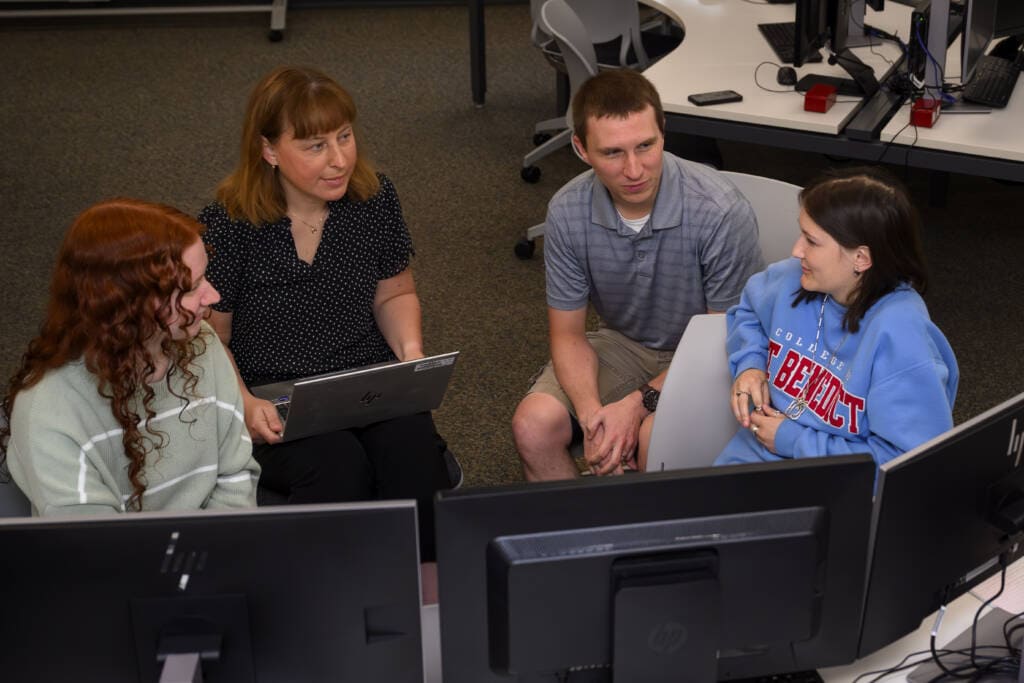
An example of that synergy can be found in the research project College of Saint Benedict juniors-to-be Ava Packer and Emily Berndt are working on this summer in collaboration with associate nursing professor Dr. Jodi Berndt and associate computer science professor Dr. Peter Ohmann.
The team is creating a web platform that will allow nursing students to conduct actual conversations with a wide range of AI personas, simulating real interactions with physicians, patients and family members they will experience in the workforce. The system is being designed to simulate those interactions and provide feedback on the student’s communication skills and ability to show empathy.
“This is a project that hopefully will be used by other students here for years and years to come,” Packer said. “It’s a great idea, and I love being part of something I can pour my energy into – knowing that whatever I put into it will be taken out of it by thousands of others.”
This marks the third time professors Berndt and Ohmann have joined forces to create tools designed to enhance the educational experience for students.
The first collaboration resulted in Maestro, a bar-code scanning system designed by computer science department students to replicate the one nurses use to administer medication in hospitals. That program – designed in 2020 – is still widely used by all students in the nursing department throughout the curriculum.
Then, in 2023, another cooperative effort led to the development of a virtual simulation program.
This time around, Jodi Berndt was looking for a way students could gain needed experience interacting directly with patients and providers.
“They can update doctors as nursing students, but because they’re not licensed, they can’t receive orders from a provider,” said Berndt, who is a registered nurse at the St. Cloud Hospital and has been working in the intensive care unit the past 25 years. “Students interact with patients and families during clinical experiences, but faculty are not able to observe every interaction and provide the feedback that’s needed in order to improve therapeutic communication skills.”
“I’ve been in nursing education for 17 years,” she continued. “After hearing so much concern about the use of AI in education at nursing conferences, I tried to think of how we could use AI for good here on campus.
“It occurred to me that one answer was to use it as a communication tool and help our students gain the skills they are going to need to communicate better with patients, providers and families when they get into the field.”
Under Ohmann’s technical direction, Packer and Emily Berndt are writing the code needed to create the AI personas the program will offer. Those personas and scenarios are based on data Jodi Berndt has provided based on her 25 years in the health care field.
The scenarios will include providing updates to a physician, obtaining consent from a family member, completing an admission interview, triaging patients in an outpatient setting and providing patient education. More will likely be added as the platform continues to be developed.
The AI tool will then provide feedback that can be shared with faculty to help the students develop goals for improving their communication skills.
“Say you select surgical, then you’ll get a list of all these different patients, providers and family members,” said Emily Berndt, a double major in computer science and political science with a minor in psychology. “From there, you’ll be able to select an encounter.”
“It will show you all the demographic information about the persona and what the situation is,” added Jodi Berndt, herself a 1998 CSB graduate.
“We’ll program information into the AI prompt to guide the AI-generated persona in answering the nurse’s questions. The persona will be programmed to have a specific temperament and health literacy level to simulate the variety of people and personalities that nurses will encounter in the health care setting.”
The hope is the platform will be ready for use in classrooms by the start of the academic year this fall.
“We were part of a software development team in class this past school year, and that was great in terms of learning the software and the development pipeline,” said Packer, a double major in both computer science and art. “But this is even bigger because we’re doing the actual design. There’s no substitute for getting hands-on, actual experience.”
“I’m definitely looking at a career in computer science, and health care software is something that interests me,” Emily Berndt added.
“I see the number of ways AI, for example, is being put to use in that field and it’s only going to grow in the years to come. Having the chance to build a project like this from the ground up is such a valuable opportunity.”
Ohmann, who graduated from SJU in 2010, said this kind of cross-collaboration between departments benefits both sides.
“Our students are going to have to know how to work with these kinds of tools in the professional world,” he said. “There’s no doubt about that. And this is providing them with experience that also has a tremendous benefit to other areas on campus.
“It’s a project that’s going to make a huge difference when these two students go out and start applying for jobs. They can demonstrate they’ve had experience developing programs actually being used.”
Maestro was estimated to save the nursing department around $20,000 per year compared to the purchase of professional software, and it remains in use by every student at the undergraduate level.
In the case of this project, the cost savings can’t be estimated because such a platform does not currently exist.
“There’s nothing really like it now, so we wouldn’t know what it would cost,” Ohmann said. “There is no product like this available to purchase.”
“Not yet anyway,” Jodi Berndt added. “That’s what makes this so important.”
The plan is to begin using the new software in Jodi Berndt’s graduate-level informatics course, then expand from there for use in both undergraduate and graduate programs.
“Eventually, we expect to implement it into all of our clinical nursing courses,” she said. “Even something like pathopharmacology, where they’re learning about different medications and how they work. They could run a scenario on this platform where they’re teaching patients about correct medication usage.
“There’s an application for this, I think, in almost every nursing course we have in the curriculum.”
The project is groundbreaking enough that Packer, Ohmann and Emily and Jodi Berndt are hoping to present it at the American Association of Colleges of Nursing’s annual conference in Indianapolis this December – one of the largest nursing education conferences in the nation.
“Having the chance to build something like this from a language we just learned two weeks ago is such a valuable learning experience,” Emily Berndt said. “It’s helping us gain a lot more confidence in our own skills.”
“I have so many friends who are in nursing here, and I’m already going around bragging to every one of them,” Packer added. “I’m writing something they’re all going to use.
“That’s a pretty amazing feeling as one of their fellow students.”
